-
COMMUNICATE
Talk effectively with your teen about being a safe driver.
-
SIGN UP / SIGN IN
Sign up to use the free, research-based Parent-Teen Driving Agreement. Make your teen driver safer starting now!
-
AGREEMENTS
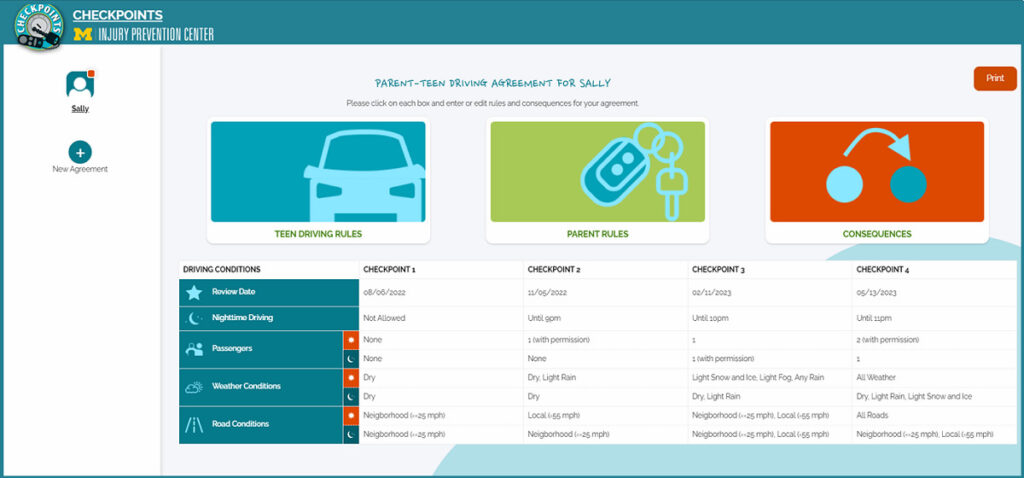
Create a new agreement or view/edit your saved agreement(s).
-
PROGRESS
Help your teen continue safely by revisiting your Parent-Teen Driving Agreement.
COMMUNICATE
Clear communication! It's the first step to keeping teen drivers safe. Parents and teens need to know what expectations are related to the teens' driving: privileges and rules when the teen is first licensed; how he/she can earn more driving privileges; and consequences for breaking rules and privileges. This website provides resources to help parents communicate with their teens:
SIGN UP / SIGN IN
Sign Up To Start Your Driving Agreement
Sign In To Your Account
Forgot Your Password?
Why am I being asked for this information?
To use the interactive parent-teen agreement you must create a username and password. This will allow you to save your agreement and return to it in the future. The items that are required are needed to use the interactive agreement.
Telling us how you heard about the website will help us make it available to more parents.
Your privacy is important. Your information is safe and will not be sold or shared with anyone. See our Privacy Policy for more details.
AGREEMENTS
Sample Agreement
- Driving Conditions
- Start Date
- Review Date
- Nighttime
- Teen Passengers
- Daytime
- Nighttime
- Weather Conditions
- Daytime
- Nighttime
- Roads
- Daytime
- Nighttime
- Checkpoint 1
- 05/25/2013
- 06/24/2013
- Until dark or 9 pm
- None
- None
- Dry only
- Dry only
- Neighborhood
- Neighborhood
- Checkpoint 2
- 06/24/2013
- 07/24/2013
- Until 9 pm
- 1, with permission
- None
- Dry, light rain only
- Dry only
- Local
- Neighborhood
- Checkpoint 3
- 07/24/2013
- 08/23/2013
- Until 9:30 pm
- 1
- 1, with permission
- Moderate only
- Dry, light rain only
- All but high speed
- Local
- Checkpoint 4
- 08/23/2013
- 09/22/2013
- Until 10 pm
- 1
- 1
- Most
- Moderate only
- Most
- All but high speed
Click here for sample Driving Rules
Sample Rules
Teen Driver Will:
- Never play around with passengers, talk on a cell phone, mess with the radio or do anything else distracting
- Always call home if for any reason it is not safe to drive or ride with someone else
- Always call home if going to be late
- Always wear a safety belt and require all passengers to wear safety belts
- Always obey all traffic laws
- Never speed, tailgate, or cut off others
- Never drive after taking any drugs or alcohol or ride with a driver who has taken any drugs or alcohol
- Always tell parent/guardian where going and with whom
No teen driver rules have been setup.
Parent Will:
- Provide safe ride home when asked (no questions at that time)
- Consider necessary exceptions to the driving privileges
- Apply rules fairly and consistently
- Point out and discuss safe and dangerous driving situations and practices
- Be a good role model behind the wheel
No parent rules have been setup.
PROGRESS
The interactive parent-teen driving agreement is designed to help parents monitor their teen's progress and gradually increase his/her privileges to allow driving in more complex driving situations as your teen's skills improve.
Here's How It Works:
- 1
You will receive an automated email on the end date of your current Checkpoint reminding you that it is time to re-examine your parent-teen driving agreement.
- 2
Go to the Agreements section with your teen and look at your agreement together. Discuss the driving experience your teen has gained and if his/her driving privileges should be changed in the next Checkpoint.
Did your teen follow the agreement?
Improve his/her driving skills?
Get enough experience to extend his/her driving privileges to include some higher risk situations?
- 3
Add a new Checkpoint with your teen's new privileges and set an end date for the new Checkpoint.
Click here to view a sample agreement with driving privileges gradually increased over four months.
LEARN
When it comes to teen driving and helping teens be safer drivers there is a lot we all need to learn. The good news is that there is important knowledge about teen driving that can help parents. This page provides information for parents from teen driving experts and researchers.
THE RISKS
Teen Passengers
Crash risks are nearly double with one passenger and increase even more with each additional passenger. This is true for all teens, even those who are responsible and trustworthy.
With a Level 2 License, teens cannot have more than 1 passenger under the age of 21 (unless the passenger is a member of the driver's immediate family or the driver is traveling to or from school or a school-sanctioned event between 5 a.m. and 10 p.m.).
Recommendation
Initially, limit your teen to NO teen passengers, and gradually increase passenger privileges as your teen gains more driving experience.
THE RISKS
Nighttime Driving
The most severe teen crashes occur at night. Night driving is more dangerous because of limited visibility, fatigue, and drinking drivers on the road.
With a Level 2 License, teens cannot drive from 10 p.m. to 5 a.m. However, higher rates of serious teen driver crashes begin occurring as early as 9 p.m.
Recommendation
Set an early evening restriction for your teen's unsupervised driving - sundown during the first months with a license and gradually later as your teen gains more driving experience.
THE RISKS
Bad Weather
Bad weather makes driving more dangerous for all drivers. However, teen drivers do not have enough experience to react safely in bad weather.
Recommendation
Limit your teen's driving in bad weather. Allow unsupervised driving only in good weather during the first months with a license and gradually allow unsupervised driving in more severe weather as your teen gains more experience
THE RISKS
High Speeds
As speed increases, vehicles respond more quickly to steering and more slowly to braking. Inexperienced drivers may make abrupt changes, which can make the vehicle go out of control. It takes time to learn to how to handle a vehicle at high speeds. High-speed crashes have higher crash forces and are more likely to result in severe injuries.
Recommendation
Limit your teen's unsupervised driving to familiar, lower speed roads for the initial months of licensure, and gradually allow unsupervised driving on higher speed roads as your teen gains more experience.
THE RISKS
THE FACTS
THE FACTS
Parent's Role
Crash risk is low during the learner phase when all teen driving is supervised. Crash risk quickly increases for all teens when they move on to unsupervised driving. The first months of driving independently (a Level 2 license) are the most dangerous for every new driver.
- During the Learner phase:
- Supervise teen's practice driving and provide important coaching and instruction.
- During the Level 2 license (independent driving):
- Use a parent-teen driving agreement to set privileges that give teens experience in less risky driving conditions.
- Continue to monitor their teen's unsupervised driving, including the conditions they drive in and how they are driving
- Make opportunities to ride with their teens to continue giving them supervised practice in riskier conditions.
- Frequently emphasize that their teens follow all traffic laws and the terms of their driving agreement.
- Evaluate their teen's driving and adjust their teen's driving privileges as they gain more experience.
THE FACTS
Michigan's Graduated Driver Licensing Law for Teens
Michigan's Graduated Driver Licensing (GDL) program is designed to increase the safety of new teen drivers by allowing them to gain valuable experience at each level before moving forward. Parents play a key role at each level.
The Checkpoints Program helps parents set clear driving privileges and rules for their teen's unsupervised driving during the Level 2 license.
Near the end of their teen's Level 1 license, parents can get ready for the next step in GDL by creating their own Checkpoints parent-teen driving agreement on this website and start using it when their teen gets a Level 2 license.
- Learner's permit
- Learner's license
- Restricted license
- Probationary license
- Driver's license
- Unrestricted license
- Full license
- Driver's license
- Segment 1 driver education (24 class hrs, 6hrs behind wheel, and written exam)
- Segment 2 driver education (6 class hrs)
- 50 hrs practice driving (10 at night)
- 90 days, no crash/violation Level 1 license for 6 months
- Road test
- 12 months no crash/violation
- Level 2 license for 6 months
- Vision exam
- Written approval of parents
- Certification that requirements met
- Parent signature
- Fee
- Except 10 p.m. to 5 a.m.
- With up to 1 passenger under the age of 21
THE FACTS
FAQ
How this website can help parents
-
What can I find on this website?
This website has information about the teen driving laws in MI, the risks teen drivers face when first licensed (including common myths and facts about teen driving), how parents can help their teens be safer drivers, and the Checkpoints program’s interactive parent-teen driving agreement that parents can use to set clear driving privileges, rules, and consequences with their teens.
-
How is this website different than other teen driving sites?
The Checkpoints Program presented on this website was created by researchers at the National Institutes of Health and has been tested in several research studies. It has been shown to help parents create and use a parent-teen driving agreement during the first months their teens had licenses and those teens got fewer tickets and reported fewer risky driving behaviors (like speeding, tailgating, turning fast, unsafe lane changes, cutting in front of other vehicles, going through yellow-red lights, etc.). This website is available to parents for free through a grant to the University of Michigan Transportation Research Institute from the CDC’s National Center for Injury Prevention and Control.
-
How to use this website
-
How do I use this website?
The website is designed to give you information about teen driving and to give you an interactive driving agreement that you can fill out with your teen. Here are some suggestions for finding helpful information on this website:
1. Click on the green arrows near the top of each page (starting with "Learn More" on the home page) to follow our recommended path through the website.
2. If you don't want to follow the path of green arrows you can use the menu bar (located under the top banner on each page) to jump to specific pages.
3. If you want to straight to getting started on an agreement you can click the "Sign Up" arrow on the homepage.
-
THE FACTS
Latest News
Cell phone ban for teen drivers is in effect
Teen drivers with a Michigan Level 1 or Level 2 Graduated Driver License may not use a mobile/cellular phone while driving to make a call, answer a call, or engage in any verbal communication. Under Kelsey's Law, teens could face up to $295 in fines and costs if ticketed. Click here for more information about Kelsey's Law.
Texting while driving is illegal for all drivers in Michigan (both teen drivers and adult drivers).
Governor Snyder signs bill banning cellphone use by teen drivers
Senate Bill 756 (now Public Act 592 of 2012) bans cellphone use by all drivers on a Level 1 or Level 2 license in Michigan. The new law allows primary enforcement by police and will take effect in late March 2013.
For more information see the news release from michigan.gov
http://www.michigan.gov/minewswire/0,4629,7-136-3452-292407--,00.html
Or, the text of Senate Bill 756
Nationwide survey shows correlation between parents' and teens' distracted driving
The University of Michigan Transportation Research Institute and Toyota Motor Sales USA Inc. surveyed more than 2,600 newly licensed U.S. drivers ages 16-18 and nearly 3,000 parents of drivers in this age group, including 400 pairs of teens and parents from the same households. Parents who were more likely to engage in distracting behaviors while driving (like talking on a cell phone, texting, eating or drinking, looking for something in the vehicle) were more likely to have teens who did the same. A key finding is that what teens think their parents do while driving has a greater impact on teen behavior than what parents actually report they do. This is important because teens think their parents engage in distracted driving more often than may be the case.
For more information see these articles:
"Driver distraction: Do as I say, not as I do (or what you think I do)"
"Are you a good driver? Ask your teenager"
http://www.forbes.com/sites/joannmuller/2012/11/28/are-you-a-good-driver-ask-your-teenager/
May-June 2012 statewide Click It or Ticket campaign launched
The Michigan State Police/Office of Highway Safety Planning have launched a new statewide Click It or Ticket campaign. The effort includes a new ad campaign and safety belt enforcement zones throughout the state from May 22 - June 4.
For the first time, the campaign includes ads specifically directed at a teen audience; teens and young men (age 16-29) are the two groups least likely to wear seat belts. The new campaign also includes more areas conducting safety belt enforcement zones than past campaigns.
http://www.michigan.gov/msp/0,4643,7-123-1586_1710-143247--,00.html
Michigan's New Teen Driving Laws Took Effect March 30th, 2011!
Beginning March 30, 2011 all Michigan teens driving on a Level 2 license have two new restrictions:
1) A new passenger restriction prevents teens from having more than 1 passenger under the age of 21
2) Driving between 10 p.m. and 5 a.m. is prohibited unless driving to or from employment, or with a parent, legal guardian, or licensed adult over 21 years old.
For more information about these new restrictions check out this special website provided by the Michigan Office of Highway Safety Planning:
Teens Do Better With Parents Who Set Limits
Studies show parents who keep set boundaries make a huge difference to their childrens' health and well being. Teen drivers whose parents set and enforced rules were more likely to wear seat belts and less likely to speed, get in crashes, drink and drive, or use cellphones while driving.
http://www.usatoday.com/news/health/painter/2010-02-08-yourhealth08_ST_N.htm
MI Senate Passes House Measure to Change Teen Driving Laws
The Michigan Senate passed House Bill No. 4493 on Thursday, December 2, 2010. Under the bill, new teen drivers would face new restrictions on nighttime driving and carrying teen passengers.
http://www.mlive.com/politics/index.ssf/2010/12/complete_round-up_of_michigan.html
MI House Passes Bill to Change Teen Driving Laws
The Michigan House of Representatives passed House Bill No. 4493 on Wednesday, November 10, 2010. Under the bill, new teen drivers would face new restrictions on nighttime driving and carrying teen passengers.
National Teen Driver Safety Week is Oct. 17-24
October 17 - 24 is National Teen Driver Safety Week and the focus this year is on reducing driver distractions.
http://www.michigan.gov/som/0,1607,7-192-53480_56420-245210--,00.html
SHARE
Parents who have used the parent-teen driving agreement have shared some of their experiences using it with us. Here's what they had to say:
“She has been taught to handle normal driving situations, but I still have concerns about her driving at night or in bad weather, because she has little experience in those situations.”
- Carlos G.
“My son realizes he has to clear every trip with his mother or me. It give us peace of mind. Besides, when we know he'll be out, we can have him do some errands that we need to have done.”
- Emilio F.
“When other teens are in the car, my main concern is Brian trying to do all kinds of daring things. That's why I limited his driving with friends during the first months after he got his license.”
- Robert F.
“Chuck can become over-anxious, especially in traffic. That's why I frequently talk to him about being calm and under control when driving.”
- Harold
“I worry about my daughter driving at night. This is why I will personally supervise any nighttime driving she does for at least the first 3 months after she gets her license.”
- Roger F.
We'd like to hear from even more parents. Click here if you have a comment you want to share.
CONTACT US
PRIVACY
Last modified March 17, 2010
The Checkpoints Program was developed by Dr. Bruce Simons-Morton of the National Institute of Child Health and Human Development, an agency of the U.S. Department of Health and Human Services.
This website was created as part of a research study funded by the Centers for Disease Control and Prevention National Center for Injury Prevention as a way to give parents free, online access to the Checkpoints Program.
We believe that your personal information belongs to you. We have included some questions on the Registration page asking for information about you and how you learned about this website. This information is an important part of the research study and will help us evaluate how to make this website available to a wide audience of parents. The information will not be rented or sold to third parties. It will not be used in any way to attempt to sell you goods or services of any kind. It will be kept completely confidential.
Important data for this research study will be collected when you visit the website, including standard information that your browser sends to every website you visit, such as your Internet Protocol address, your browser type and capabilities and language, your operating system, the date and time you access the website, and the website from which you linked to our website, as well as your activity on the website. This information will help us improve the quality of the information provided to parents on the website and make access to the website easier. The information will not be rented or sold to third parties. It will not be used in any way to attempt to sell you goods or services of any kind. It will be kept completely confidential.
If you choose to receive email reminders from us to add new Checkpoints to your Parent-Teen Driving Agreement, but later wish to stop receiving such communications, you may do so at any time by simply following the instructions included in the emails.
Username And Password
When you register on the website to receive access to the Interactive Parent-Teen Driving Agreement you will be asked to choose a password for your account, in which case your online account information shall be protected by your password. We recommend that you do not disclose your password to any other person. You are responsible for maintaining the confidentiality of your password and account, and are fully responsible for all activities that occur under your password or account.
Links To Other Sites
The Resources page of this website contains links to the websites of other agencies and organizations that provide information about teen driving. Please be aware that this website is not responsible for the privacy practices of other websites. If you submit any personal information to another website after clicking on a link from saferdrivingforteens.org, you are not submitting that information to saferdrivingforteens.org and saferdrivingforteens.org has no control over the collection and/or disclosure of that submitted information. We encourage our users to be aware when they leave our site and to familiarize themselves with the privacy statements of every website that collects personal information.
Children's Privacy
We do not seek or knowingly collect any personal information about children under 18 years of age. If we become aware that we have unknowingly collected personal information from a child under the age of 18, we will make reasonable efforts to delete such information from our database.
Governing Law; Visitors Residing Outside The United States
This Privacy Policy and the privacy practices of saferdrivingforteens.org will be subject exclusively to the laws of the State of Michigan within the United States of America, without regard to its conflict of law principles. We make no representation that this Privacy Policy and such practices comply with the laws of any other country. Visitors who use the website and reside outside the United States do so on their own initiative and are responsible for compliance with local laws, if and to the extent local laws are applicable. If you reside outside of the United States, by using our website, you consent to the transfer and use of your information outside your country. Without limiting the foregoing, by providing any personal information to saferdrivingforteens.org, all website visitors, including, without limitation, website visitors in the member states of the European Union, fully understand and unambiguously consent to this Privacy Policy and to the collection, storage, and processing of such information in the United States of America.
Updates to this Policy
We reserve the right to update our Privacy Policy from time to time. When we do, we will post a notice on the website for a reasonable period of time after such changes are made that this Privacy Policy has been updated and we will revise the "Last modified" date at the top of this Privacy Policy. We encourage you to check this page periodically for any updates. Your continued use of the website following the posting of updates to this Privacy Policy will mean you accept those updates.
Contact Us
If you have an questions about our Privacy Policy, please feel free to contact us.
ABOUT
Program Goals
Injuries from motor vehicle crashes are the #1 cause of death for teens in the United States. The main reason driving is more dangerous for teens, is that they are young and not experienced at driving unsupervised.
Many parents struggle with wanting to let their teens start driving unsupervised and knowing how to keep their teens as safe as possible when they are not in the vehicle with them.
The goals of the Checkpoints Program are to help parents by:
- Giving parents facts about teen driving safety.
- Showing them things they can do to make their teen's driving safer.
- Giving them an interactive parent-teen driving agreement so they can set clear guidelines for their teen's early driving and make changes as their teen progresses.
Program History
The Checkpoints Program was developed by Dr. Bruce Simons-Morton of the National Institute of Child Health & Human Development, an agency of the U.S. Department of Health & Human Services. It has been tested by parents and teens in several U.S. states, including Michigan.
This website was developed with support from the National Center for Injury Prevention and Control of the Centers for Disease Control and Prevention.